


Claire Ragozzino on the slow, deep work of turning an ancient science into a way of living
Claire Ragozzino, Ayurvedic educator, cook and founder of Vidya Living, came to Ayurveda through her own health struggles and chose to dig one well deep. Twenty years and two books later, she talks about how that depth led her back to simplicity, and where a woman with almost no time to spare might begin.
- How did you first find your way to Ayurveda?
Like many, I came to Ayurveda first through yoga, but what ultimately led me to both yoga and Ayurveda was my own health struggles. Digestive challenges shaped much of my childhood, so I turned to food as medicine in my teenage years, seeking answers. It was still very fringe at the time, especially for someone my age. For years, I bounced between elimination diets, cleanses, superfoods, and supplements, always looking outside myself for the fix but never quite finding it. I was treating wellness the way so many of us do today, like a buffet: a taste of everything and depth in nothing.
I’d come across Ayurveda through Dr. Vasant Lad’s Ayurveda: The Science of Self-Healing at our local health food store, but it wasn’t until my early twenties that I made a real commitment to this as my path. There’s a saying about digging one well deep until you reach water, and that’s what I chose to do. I stopped treating Ayurveda as something to be cognized and started living it every day. That’s when things shifted. My body began to heal, I learned to trust myself, and I came to understand what health actually feels like.
- You take complex Ayurvedic concepts and present them as lifestyle choices, the kind a woman would sign up for even without fully understanding Ayurveda. That kind of simplicity usually comes from experience. What experience of your own guided you to present it this way?
Learning Ayurveda tends to follow an arc, and I went through it myself. At first it feels intuitive and exciting. I noticed immediate changes. Then, as you go deeper down the rabbit hole, it can become daunting and downright overwhelming (all the Sanskrit terms, which dosha is pushing or blocking which?). You start to doubt yourself and overcomplicate things. Eventually there’s a homecoming to the simple truths you saw at the very beginning through your lived experience.
That idea of caring for ourselves thoughtfully, day by day, is the thread running through both of my books. My hope is to take the confusion out of Ayurveda and make it approachable, while still honoring the classical texts and traditions and making it relevant to a modern audience. The simplest practices and approaches are often the most sustaining and, in turn, the most effective.
- Before my own Ayurveda training, I read many books on the subject and came away overwhelmed. Dense pages full of unfamiliar Sanskrit terms were hard for me to take in. Living Ayurveda, and the images across your work, reached me before I ever started school. Are the white space and the beauty in your book and your brand a conscious choice, and what do you hope they do for the reader?
Yes, very much so. White space is a form of breathing room. In Ayurveda, space (akasha) is the first of the five elements, the container that everything else arises from. When a page is crowded, the mind has nowhere to rest. When there’s space, we can actually take in what’s in front of us. I wanted the book to feel sattvic: clear, light, and calm, the way you feel after a good morning routine. Through the imagery, I wanted to show that nature, the food we eat, and our bodies are one and the same.
Light was the other conscious choice. I wanted to show the arc of the seasons through it, so I shot spring in soft light with blue tones, summer in bright light with high contrast, fall with a warm glow and long shadows, and winter in quiet gray tones. Light signals to the eye the movement of the sun and thus the ways we shift our routines.
I also didn’t want the book to feel tied to one place. I live in the tropics, I spent a stint in New Mexico during the pandemic, and the cover was shot in Sri Lanka during the COVID lockdown, but my aim was for it to look and feel like anywhere, so readers could see their own kitchens and their own seasons in it.
Above all, I wanted simple food and open spaces to reflect the beauty of small, ordinary things: a single ingredient, an intentional altar, a bowl of warm soup. Ayurveda isn’t something you have to master before it can help you. Beauty draws you in before the theory does, and I think that’s how many of us learn best.
“Beauty draws you in before the theory does.”
- Whether it’s cooking a meal or styling a photograph, your work takes time. What does slowness make possible in your work that speed would take away?
I won’t lie: I struggle with the pace of social media trends and expectations. I can’t churn out ten reels a week, nor am I interested. I’m a still-photography girl, and I need to take my time. I need to watch how the light changes and feel a personal connection to what I’m creating.
Slowness is what lets me notice things: the way steam catches the morning light, or the moment a table finally feels right. Speed would rush me past all of that.
Fast content just isn’t something I enjoy, and I think the more we give ourselves permission to slow down while we create, the more we enjoy the process. Deadlines also ramp up my pitta! I can easily burn myself out trying to do too much. That’s a lesson I’ve had to relearn while publishing two books.
- Your work follows both the seasons and the moon, so it moves in monthly rhythms as well as yearly ones. How can living with these rhythms help a woman recognize her own needs and make choices she trusts?
Living by the natural rhythms gives us a map for our own inner weather. In Ayurveda, each season carries the qualities of a dosha: the dry, airy winds of vata in autumn and early winter, the heavy, damp kapha of late winter and spring, and the heat of pitta in summer. When we know what’s happening around us, it’s much easier to make sense of what’s happening within us. That restlessness in October or that sluggishness in March isn’t a personal failing. It’s nature moving through us.
The moon brings the same wisdom into a shorter, more intimate rhythm. Many women already live in a monthly cycle, and the moon gives us a gentle reminder to pause and check in. The new moon can be a time to rest, reflect and set intentions, and the full moon a time to gather, celebrate and release. Over months and years, you start to notice your own patterns: when your energy rises, when you need more rest, when certain foods feel nourishing and when they don’t.
That’s where self-trust comes from. It isn’t from following someone else’s rules, but from paying attention long enough to recognise your own needs. The rhythms give us a framework, but the real teacher is our own observation. And when you’ve seen your patterns repeat, you can make choices with confidence, knowing they come from your own lived experience.
“That restlessness in October or that sluggishness in March isn’t a personal failing. It’s nature moving through us.”
- Many Souveraine readers are mothers of young children, building a business while working a part-time job. For a woman with that little time to spare, where would you suggest she start with Ayurveda, without making wellness another responsibility?
The simplest place to start is observation without judgment. If you’ve ever walked the halls of Kripalu, you may have seen this line from Swami Kripalu: “The highest form of spiritual practice is self-observation without judgment.” I took that to heart. Starting the day with loving awareness and a curious mind can be the most impactful practice of all: How am I feeling? What do I need today? It takes less than a minute; there’s nothing to buy and nothing to schedule, and you can do it while the kettle boils or before the kids wake up. It’s something to begin with, and something to anchor to when life gets busy.
- Where is your work going next?
I have a new book coming out in February!
The Omnivore's Ayurveda Cookbook. It’s been five years in the making, so it’s a real joy to finally share it with the world. I’m also growing my Living Ayurveda membership and bringing all my offerings together in one cohesive space, where our community can gather and live Ayurveda through the seasons. And I’m relishing the chance to create more in-person retreats, places where we can come together offline.
CLAIRE RAGOZZINO is a cook, writer, Ayurvedic educator, and the founder of Vidya Living. With over twenty years of study and teaching in Yoga and Ayurveda, she serves on the faculty of several Ayurveda and herbalism schools. She is known for her bestselling books, Living Ayurveda, translated into three languages, and The Omnivore's Ayurveda Cookbook. Her work bridges classical Ayurvedic wisdom for the modern eater, making this ancient science accessible for everyday living. Her writing and photography have also appeared in online and print publications, exploring topics of food, culture, and our relationship to the natural world. Visit www.vidyaliving.com to join her cooking classes, learning immersions, and international retreats.
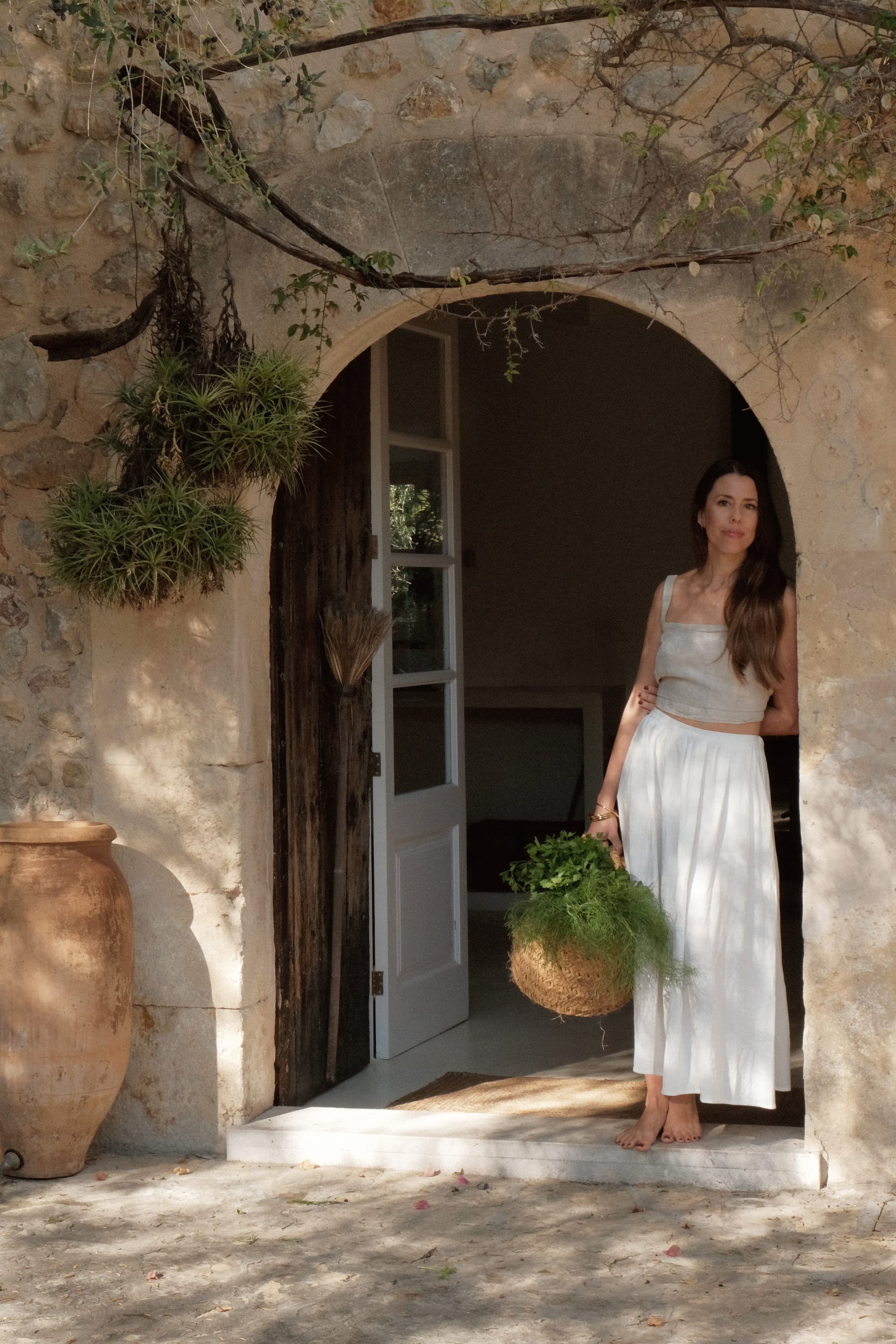
Photo Credits: Laura Wencker
Interviewed by Dhivyaa Chelvan, Editor, Souveraine.


