


With perspective from Sanae Ishida, author of Shibui: The Japanese Art of Finding Beauty in Aging
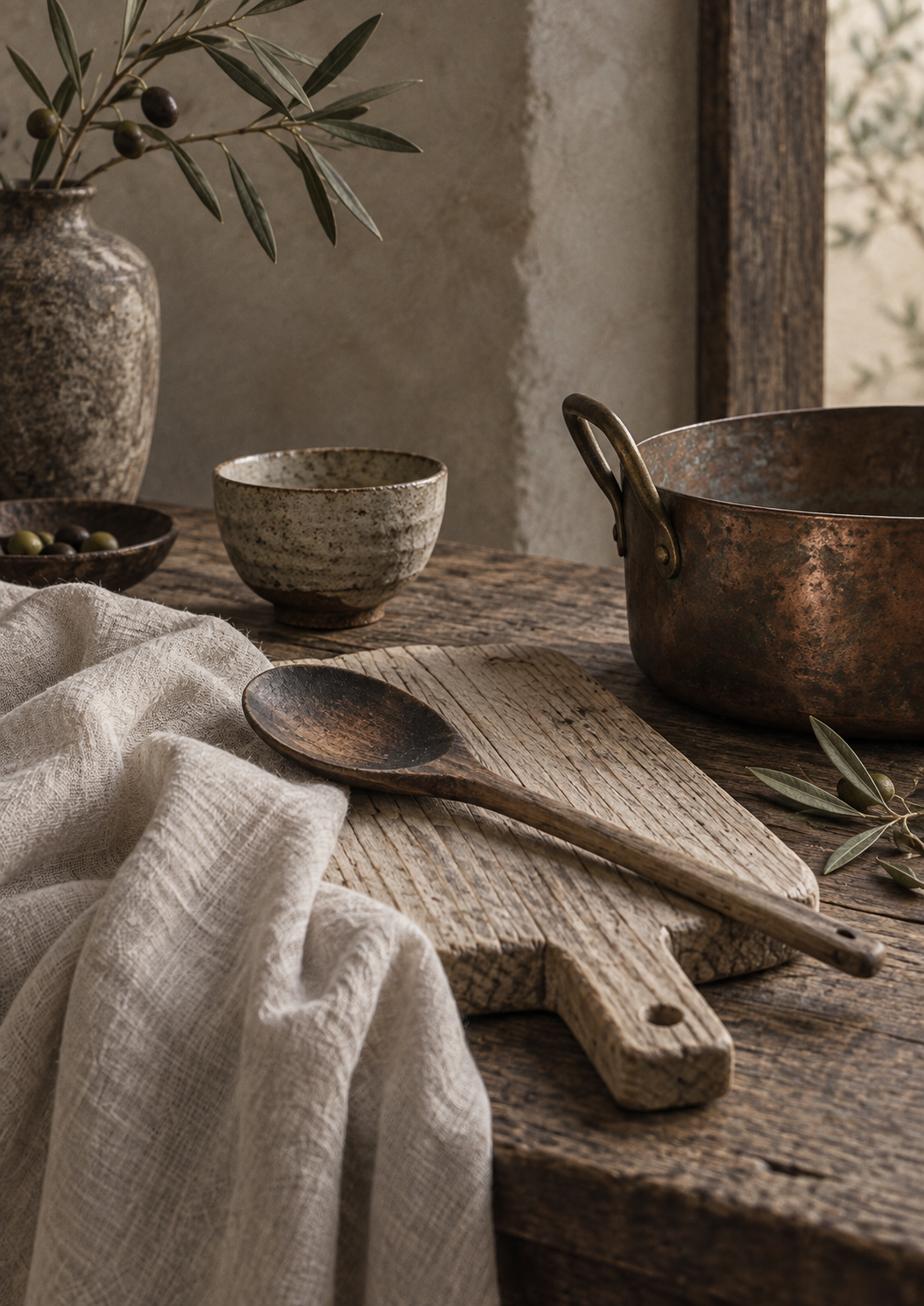
There is a wooden spoon in my kitchen that I have used almost every day for eleven years. It is darker at the handle than at the bowl, where my hand goes. It was not beautiful when I bought it.
You will have something like it. A linen sheet that took years to soften. A cutting board gone pale and grooved where the knife always lands. A pan whose base no longer matches the rest of it.
None of those marks could have been chosen in a shop. They arrived through use, and they could not have arrived any faster than they did. Their beauty is not something they were made with. It is something time made visible.
Japanese has a word for this that we do not really have in English. Shibui. A beauty that is quiet rather than announced, restrained rather than decorated, and whose depth takes a while to come into view. A thing that is shibui does not show you everything at once. It holds something back, and what it holds back is the reason you are still looking at it years later.
It can describe an object. It can describe a room. It can also describe a woman.
And it makes room for something you are rarely offered as you get older: that some kinds of beauty are not available to the young, at any price, under any regime, because the only way to arrive at them is to have lived long enough. I wanted to begin the issue here, so that we get a different entry into the world of rejuvenation
Rejuvenation assumes a direction. Its root is juvenis, young. To rejuvenate something is to carry it back toward a condition it has already left.
I notice I read that word two ways, depending on the day.
Some days I read it the way fear does, and fear is contraction. It looks at a life and sees a slope, with the good part behind me and the task ahead being to hold my position for as long as I can. On those days everything that arrives with time is a loss, and I catch myself spending the second half of my life guarding the first.
Other days I read it the way the older women in my family would have. They were not in a hurry and had nothing to defend. What they knew is that the qualities I am most grateful to find in another woman, steadiness and the willingness to sit with me in trouble without flinching, cannot be hurried into being. Some women come by them early and usually not gently. Nobody acquires them on a schedule.
Ayurveda reads it that second way too, and has its own name for the territory. Rasayana, from rasa, the essence that moves through a thing, and ayana, the path it travels. What that describes is not a return. It is the building of something that could not have existed earlier, because it takes time to accumulate. Shibui arrives somewhere similar from an entirely different direction, through beauty rather than medicine, with no shared history between them.
Both readings are available to you at any age. You will mostly not choose between them on purpose. The way you learn to see beauty depends on what you are shown again and again. Shibui is rarely among those lessons.
Reading a face
Long before your fifties, someone will have sold you the idea that your face is a problem developing on a schedule. The vocabulary is medical now: correction, treatment, prevention, intervention. Under that vocabulary, a line is something that should not have happened.
There are other ways to look at a face. Sanae Ishida, who wrote a book about Shibui with a chapter in it called Wrinkle Reading, came to hers at a stop sign.
“The idea of wrinkle reading originated when I was at a stop sign in my neighborhood and watched an older person crossing the street. I registered with shock that the person's face was calcified in an expression of rage. It seems so obvious but it was the first time that I thought about how our daily emotions can become etched and permanent on our faces. My 94-year-old grandmother-in-law had deep laugh lines and subtle signs of sorrow along her eyebrows and forehead.
Our present-day facial permutations will eventually take root. It's impossible to avoid what we deem as "negative" feelings, but I do my best to cultivate a lighter, uplifting inner world that will one day tell a tale of wellbeing written in wrinkles and lines.”
-SANAE ISHIDA
I have been thinking about that since she sent it, mostly because it moves the whole question backwards.
It is not about what to do with a line once it is there. It is about what a face is being asked to hold, most days, for years.
Which is a gentler question than the one we are usually handed, and a harder one. Not: what has gone wrong here? But: what has happened here?
What has your face laughed through, grieved through, worried through, survived? Where has it softened? Where has it become unmistakably its
own?
A face can be read as evidence of biological change. It can also be read as evidence of a life having taken place.
Restraint
Shibui carries an idea of restraint too, and restraint is the quality I find hardest to want.
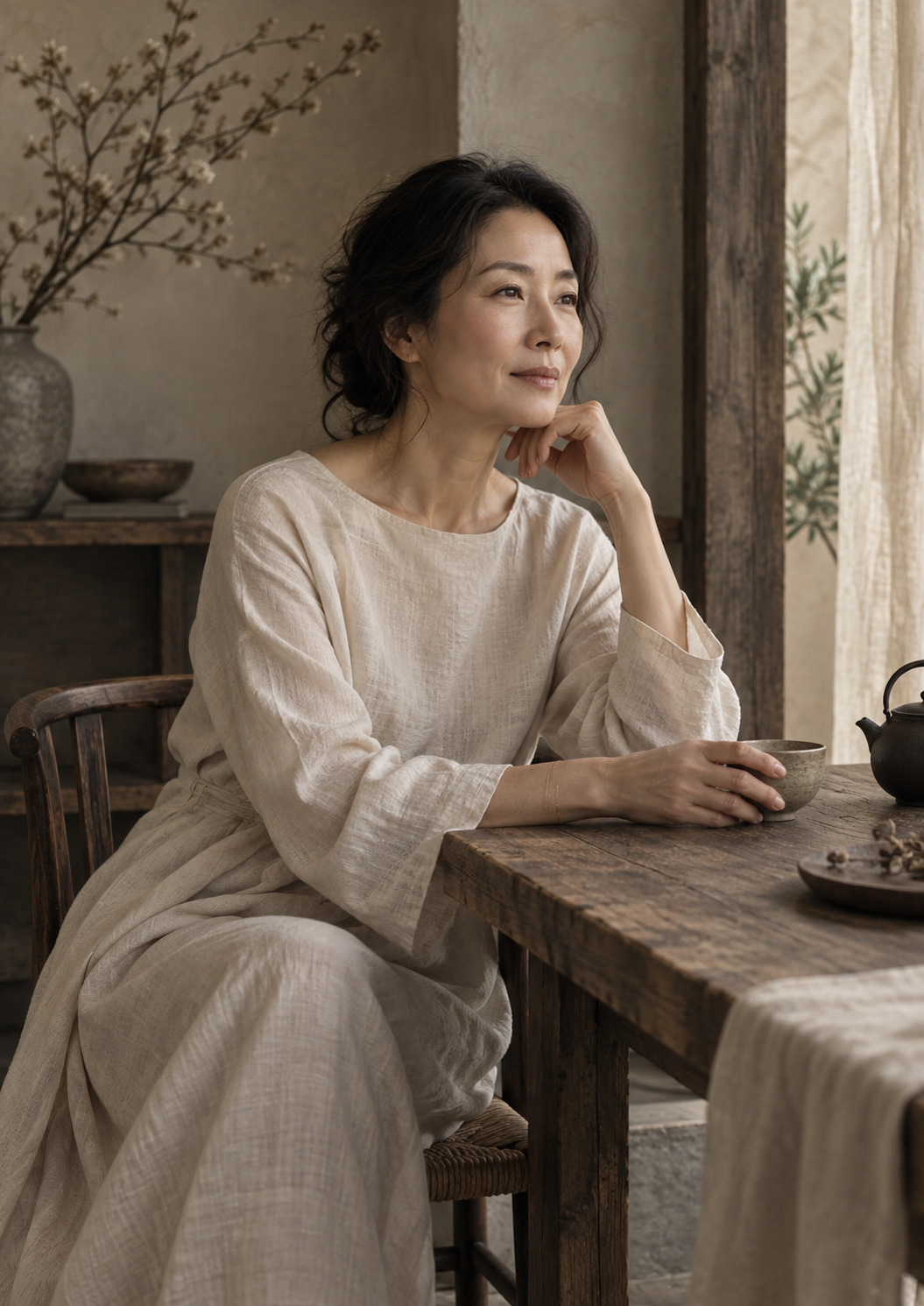
I can recognize it when I see it. The room where nothing has been added for effect. The coat that looks plain on the hanger and turns out to be the best thing in the wardrobe. The woman at the table who does not tell you what she does, and you find out later.
What they share is confidence in what has been left out. There is a word for practicing it, and it begins with dinner, called Harahachibu.
“Restraint is the foundation of the concept "Harahachibu," which is about eating up to 80% fullness. That extra space in the stomach makes digestion easier and allows for more energy and better health in the long run.
This 80% rule is widely applicable in so many other types of consumption like shopping and media. Imagine how much healthier our finances would be if we only spent 80% of our income regularly, and how much less mental overwhelm we'd suffer if we avoided social media binging and frightening global news?
Harahachibu isn't about complete abstinence but about being aware of what is enough and then adding a little constraint to provide the relief of extra space.”
-SANAE ISHIDA
The relief of extra space. I keep coming back to that phrase, because it is the opposite of how health has been sold to us. More supplements, more information, more tracking, more ways to optimize ourselves.
But some of what you need is less. Less noise. Less interference. Less performance. Less insistence that every visible change has to be managed.
It is not only an idea about beauty. Before something can deepen, something else usually has to fall away, and what is removed is often what lets the rest be seen. You will meet that thought again later in this issue in the language of rasayana, where the clearing comes before the nourishing.
What I wanted you to have
Shibui is not a practice. What it offers is a second opinion. If the only language you have ever been given is the language of anti-aging, then you have been told, in effect, that your best years are behind you and the work now is to slow the loss. I do not think that is true, and I do not think you believe it either, on the days you are not tired.
Shibui makes room for the other possibility. That certain qualities cannot be manufactured or bought, and cannot be hurried. That time is not always the obstacle to their arrival, and is sometimes the means. I asked Sanae whether there was something about growing older that she once feared losing and now understands differently.
“The fear of physical and mental decline will probably be a perennial background hum with every year that passes for me. However, I have now been managing my autoimmune condition for nearly 15 years and that fear has softened. I actually appreciate how it motivates me to take care of my health in ways that I didn't when I was younger.
Maybe "fear" isn't even the right word for how I feel about mortality and the inevitability of aging these days. It's more of an acceptance, an understanding that this is part of the human existence. It's how I'm designed. And so I do what I can to nourish myself and others and let go of what's not meant for me. ”
-SANAE ISHIDA
A perennial background hum.
She did not pretend it away, and perhaps this is what our conversation about aging has been missing. Not another argument that older women are still beautiful. The word still gives too much away.
The more interesting question is what becomes beautiful only now. What becomes clearer. What becomes quieter. What no longer needs decorating. What you stop carrying because you no longer need it to explain who you are.
The spoon was not improved by being protected. It was improved by being used almost every day for eleven years, by someone who cooked.
I think there are parts of us made beautiful in exactly the same way.
Sanae Ishida is the author of Shibui: The Japanese Art of Finding Beauty in Aging, which explores growing older through Japanese ideas of beauty, health, purpose, wealth, connection, and endings.


